
The two countries also signed three other agreements -- to enhance aviation links, to jointly work in the area of energy efficiency and promotion of parliamentary cooperation.

Admiral Sam Locklear heads the US Pacific Command, making him the most powerful military commander on earth. With 60 per cent of the US Navy under him, PACOM oversees 52 per cent of the planet. Locklear is America's military pointsman for 36 countries, including India and China.

India is failing to take advantage of its important ally, Japan as much as it should, notes Mihir S Sharma.

'The question remains: Was the Obama visit truly a success? Only the future will tell us if the "breakthrough" in the nuclear liability issue will concretise into electricity.' 'As importantly, it will be interesting to watch how India's relations with China will evolve in the months to come.'

Secretary of State for Foreign Affairs William Hague and Chancellor of the Exchequer George Osbourne, heading the largest business and ministerial delegation ever, arrived in Mumbai, their first port of call, during a two-day visit to the country.

Modi is likely to seek support of Switzerland and Mexico for India's membership of the 48-member Nuclear Suppliers Group as both these countries are key members of the elite group. The issue is likely to figure during Modi's meeting with Obama in Washington.

Modi, in an op-ed published in the Wall Street Journal, wrote that the US and India are forging a deeper and stronger partnership that extends far beyond the Beltway and the Raisina Hill.
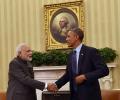
Furthering Indo-US cooperation on terrorism, Prime Minister Narendra Modi and President Barack Obama on Tuesday agreed to make "joint and concerted efforts" to dismantle safe havens for terror and criminal networks like Lashkar-e-Tayib, Jaish-e-Mohammad, Dawood-company, Al Qaeda and the Haqqani network.
"In the flux and transition of our times, the most critical need in this region is to uphold and strengthen the rules and norms that must define our collective behaviour," he said.

Amid a spurt in terror attacks in various countries, Prime Minister Narendra Modi on Thursday said terrorism is the "gravest threat" to the world, "equally impacting" India and Mozambique which agreed to strengthen security and defence ties and bolster cooperation in food security.

The India that needs strategic alliances, defence cooperation and engaging meaningfully with neighbouring countries is quietly moving ahead with confidence, says Tarun Vijay

United States Defense Secretary Chuck Hagel will visit New Delhi next week during which he will hold talks with his counterpart Arun Jaitley and other top officials, aimed at "nurturing" ties with India after the formation of the new government, a top Pentagon official has said.

Prime Minister Narendra Modi on Sunday discovered a "special connection" with Mongolia when he entered the Buddhist country's Parliament to deliver a speech, the first foreign leader to do so on Sunday -- a holiday.

India said a new mechanism will be set up for issues relating to trade and investment.

'The Modi government will do well to thrash out a national consensus before taking the leap and put itself in America's pouch,' says Rajeev Sharma.

Combating threat of terrorism and radicalisation are expected to figure high on the agenda of the talks between Modi and the leadership of Saudi Arabia, a country known as spiritual home of Islam which recently has formed a major coalition of 34 Muslim nations to fight terror, particularly the Islamic State.

'A lot of people,' says India's Ambassador to the US, 'are struggling how to define this relationship.' Aziz Haniffa/Rediff.com reports from Washington, DC.
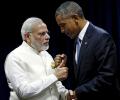
Even as Barack Obama administration officials believe that the India-US relationship has now "emerged at the world stage" and is no longer a "restricted to narrow" South Asia or subcontinental set of issues, they also concede that America's security partnership with Pakistan over the years still poses challenge to India-US relationship.
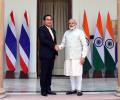
Thailand's importance to India's Act East policy is too significant to be overlooked.

Prime Minister Manmohan Singh on Sunday left for a five-day visit to Russia and China.

Moving ahead with their new mantra -- Chalein Saath Saath: Forward Together We Go -- Prime Minister Narendra Modi and United States President Barack Obama on Tuesday vowed to deepen cooperation in every sector for the benefit of global stability and people's livelihoods over the next ten years.

In the first official visit by a United States vice-president to India in three decades, Joe Biden arrived in India on Monday on a four-day tour aimed at boosting ties in key areas of trade, energy, defence and security. The US vice-president will hold meetings with top Indian leadership, including President Pranab Mukherjee and Prime Minister Manmohan Singh, on Tuesday before flying out to Mumbai in the night.

India and the United States have started discussions to jointly develop a next-generation aircraft carrier to bolster the Indian Navy's blue-water capabilities, a top Pentagon official has said.

Immediately after India launched its surgical strikes, sources said, it had informed the US of its action.

Secretary of State John Kerry arrived in New Delhi onto participate in the fourth round of Indo-US strategic dialogue even as US announced to invest $100 million in India's burgeoning clean energy sector.

The PM said his visit -- the first ever by an Indian premier -- was "based on the deep centuries-old connection between our two peoples."

'Make in India' will be central to Mr Modi's visit to Europe and Canada. It is difficult to predict what will happen with the Rafale deal, but if it goes through, it will undoubtedly become the 'Mother' of all 'Make in India' projects,' says Claude Arpi.

'If an 'informal meeting' with Xi Jinping materialises before the SCO summit in June, that itself could be regarded as a significant breakthrough in India-China relations,' says Ambassador M K Bhadrakumar.

'New Delhi showed itself willing -- at least for a period -- to tolerate the risk of conflict and to withstand Beijing's implicit and explicit threats.' 'But it also continued to try to cut some kind of deal with China to reduce tensions.'

'Today, if the international community is seeking space, if not place, here, then the message is not unclear in any which way. 'It does not reflect well on the nation's standing in the international arena, where human rights issues go a long way in building bilateral relations and benefiting from international cooperation, more than any aspect of politics and diplomacy,' N Sathiya Moorthy.

'Modi's investment in the relationship with Washington is the biggest deliverable of this visit. He means business and that's fantastic!'

Russian President Vladimir Putin arrived in New Delhi late on Friday night for annual summit talks with Prime Minister Narendra Modi on Thursday that is aimed at building on the already close strategic ties, particularly in the fields of nuclear energy, hydrocarbons and defence.
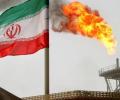
Indian Ambassador to the US Harsh Vardhan Shringla said India has stopped importing oil from Iran after the United States refused to extend exemption from sanctions earlier this month.

External Affairs Minister Sushma Swaraj told the Rajya Sabha that this is an issue of concern not just for the government and the Opposition, but the entire House and the nation shares this concern
The major driver of Mod's foreign policy can be gauged from his economic priorities such as creating employment opportunities for the youth bulge. Related to this is emphasis on manufacturing, and infrastructure development, which in turn raises the issue of FDI. He has already articulated his views on all these issues, says Rup Narayan Das.

"Japan will participate in MALABAR this year which is our largest bilateral naval exercise with India and it's scheduled to take place at the end of this month," Deputy Assistant Secretary of Defense for South and Southeast Asia Amy Searight told lawmakers during a Congressional hearing on Thursday.

Even as the United States snuggles closer to India with the thinly veiled objective of containing China, the Indian strategy is to avoid alienating either nation.

Both India and South Korea will use President Park Geun-hye's visit to unveil a comprehensive programme for mutual benefit and impacting on regional security environment, says Srikanth Kondapalli.

In a break from protocol, Netanyahu received Modi at the Ben-Gurion International Airport.

Considering Modi's style of practicing diplomacy, it is likely that a clear message would be conveyed to China that it is high time Beijing stops using its good relations with Pakistan as a pressure tactic against India. This is imperative not only for strengthening India-China relations at the bilateral level but also for maintaining stability at the regional level, says Sana Hashmi.
